
DOMAIN DECK is marketed as a domain and hosting reseller storefront with AI-assisted research and outreach tools. Rather than functioning only as a domain-name generator, it aims to help users create a branded shop where customers can search for domain names, choose extensions, and buy registration or hosting services. The operator may set retail prices and earn a margin if the underlying supplier costs are lower.
This model could interest web designers, freelancers, small agencies, and digital marketers who already help clients launch websites. But a reseller business depends on much more than a storefront. Buyers need to know which registrar handles registrations, who supplies hosting, how renewals and transfers work, and whether the advertised leads can be contacted lawfully.
Review transparency: The official page at grabdomaindeck.com/live could not be retrieved directly for this review. The feature and price details below are therefore attributed to third-party launch coverage where relevant. This is not a hands-on test; I have not purchased an account or processed a domain order through DOMAIN DECK.
What Is DOMAIN DECK?
DOMAIN DECK is promoted as a cloud-based domain and hosting storefront builder from vendor Art Flair, sold through Launchpad. A launch listing identifies November 21, 2026 as its launch date and lists a $17 front-end price. A third-party review reports a $12.41 checkout total. Since these figures conflict and the official page was not accessible, treat them as launch-period references rather than a confirmed current price.
The product’s central proposition is a branded shop where customers can search for domain names and related services. The seller can configure retail pricing and may offer hosting, website setup, design, SEO, or maintenance. Additional advertised tools include domain research utilities, AI name suggestions, expired-domain discovery, lead generation, and sales-message assistance.
It is important to separate storefront software from the infrastructure behind a domain registration. A functioning reseller operation still depends on a registrar, registry connections, payment processing, hosting infrastructure, customer agreements, and support. A polished storefront does not automatically provide all those services or remove the operator’s responsibilities.
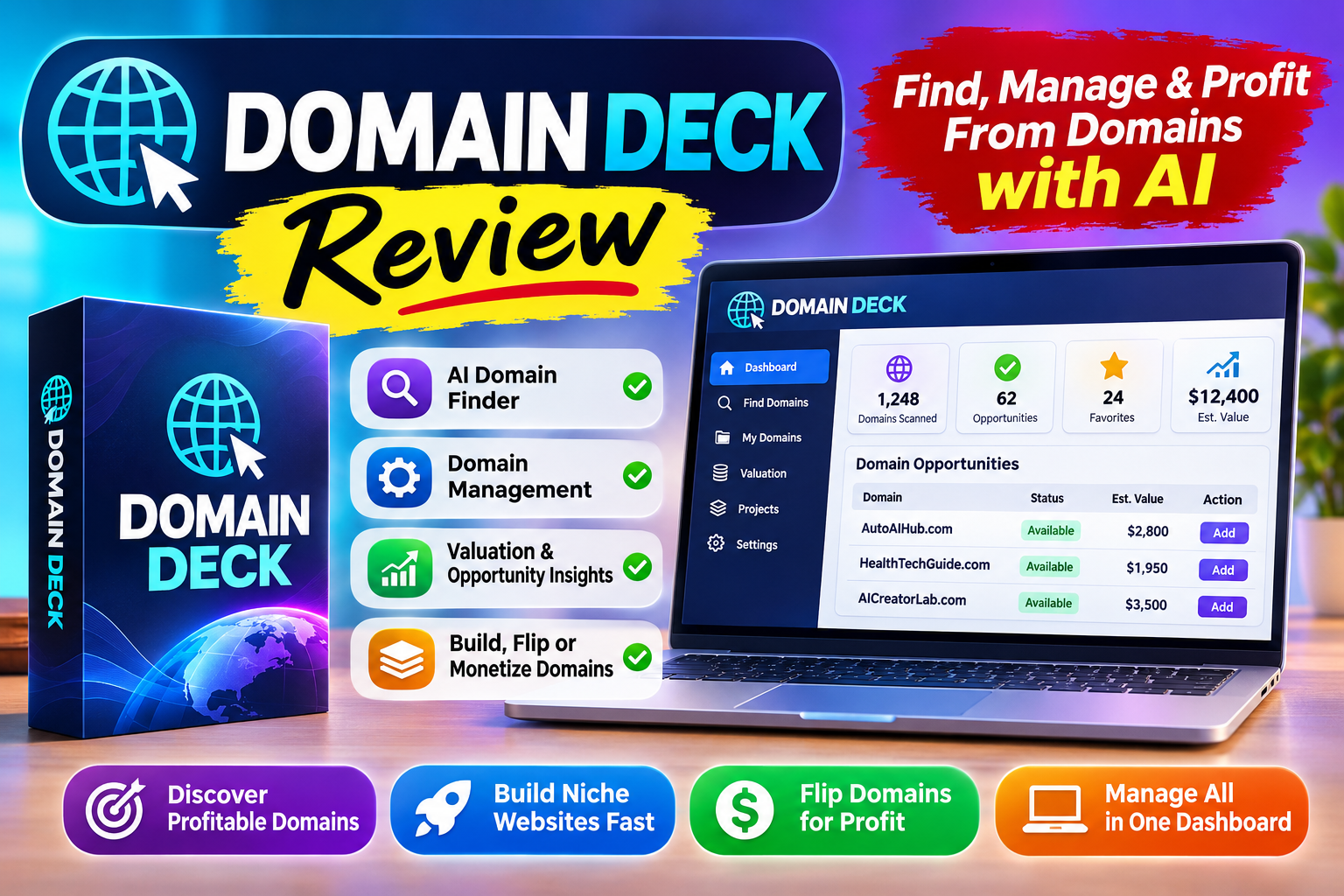
How the Reseller Workflow Is Supposed to Work
- Build a storefront: Configure a shop under your brand, select the services or extensions to offer, and publish the customer-facing page.
- Set retail prices: Choose the prices shown to customers. Your potential margin depends on wholesale costs, payment fees, taxes, refunds, and support expenses.
- Attract buyers: Promote the shop through your website, existing clients, partnerships, social channels, or compliant outreach.
- Fulfill orders: Ensure the domain is registered correctly, the customer is recorded as the registrant, and the customer can manage renewals, DNS, and transfers.
DOMAIN DECK Features: What Is Advertised?
1. Branded Domain and Hosting Storefront
The main feature is a white-label shop where a buyer can present domain registration services under a chosen brand. Customers are expected to search for a name, choose an extension, and place an order. This may suit web designers who regularly recommend domains to clients and want to keep the purchase journey connected to their own service business.
Before relying on it, confirm custom-domain support, storefront hosting, payment gateway options, customer data handling, export options, and what happens if you stop using the platform.
2. Domain Search and Custom Pricing
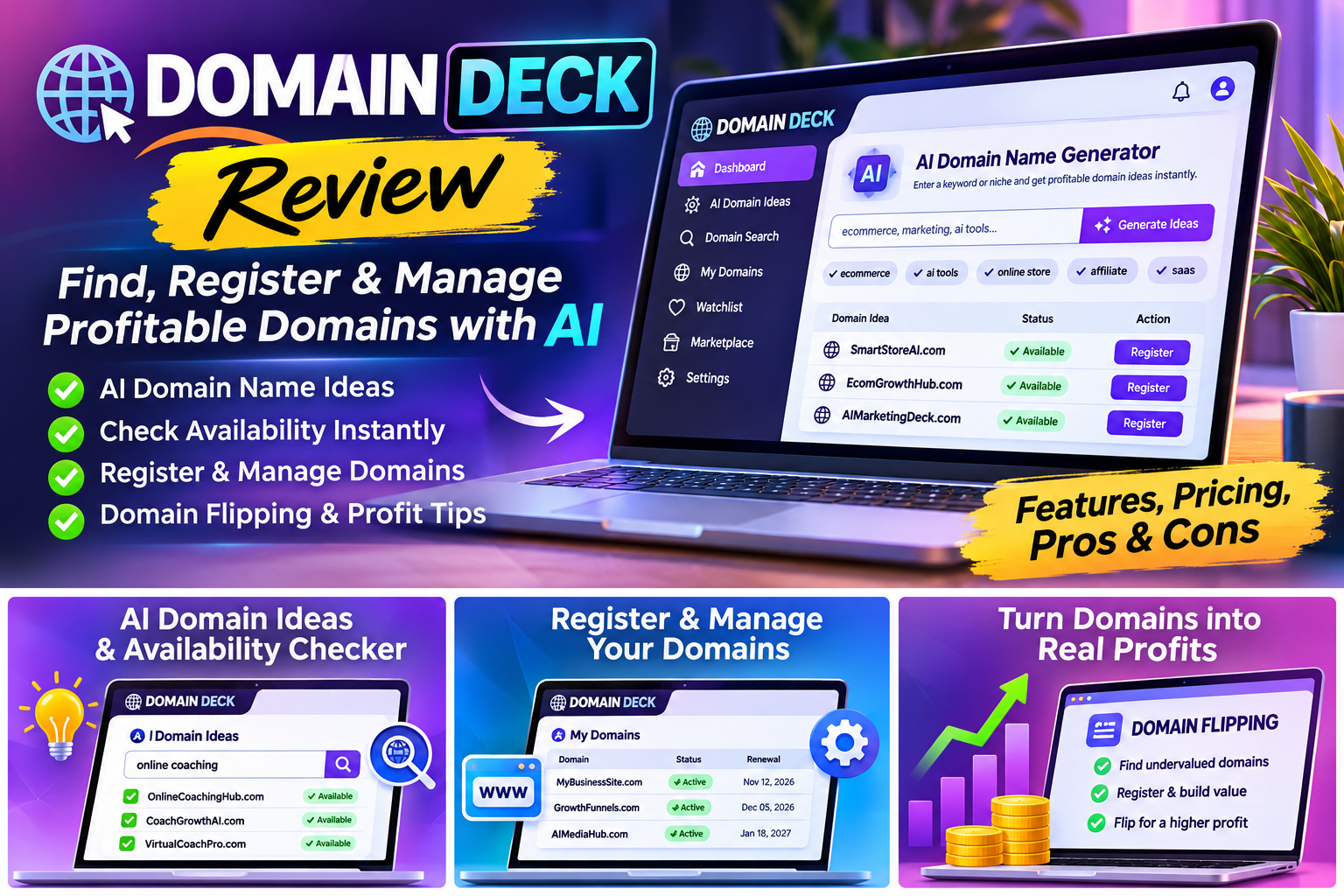
Third-party launch coverage describes a domain search feature with extensions such as .com, .net, .org, .info, and .ai, plus controls for setting retail prices. This could help an agency bundle domain registration with website design or hosting. Availability checks and final registration still depend on the underlying registrar and registry systems. A search result is not a completed registration, and another buyer may register a name before checkout finishes.
3. AI Domain Name Ideas
The platform is promoted with AI-generated domain suggestions. A user can enter a niche, keyword, or business concept and receive name ideas. This can speed up brainstorming when a client is choosing a brand or an agency is preparing options.
AI suggestions need human checks. Review spelling, pronunciation, trademark conflicts, confusingly similar names, social handle availability, and whether the name fits the business. An AI-generated name is not legal clearance and does not prove the domain is available.
4. WHOIS, DNS, Reverse IP, and Location Lookups
Launch coverage lists WHOIS, reverse IP, DNS, and domain or server location utilities. These tools may help inspect public registration information, review DNS records, or see which sites share an IP address. Similar utilities are widely available elsewhere, so compare the accuracy, update frequency, and coverage before treating them as a major reason to purchase.
5. Expired-Domain and Value Research
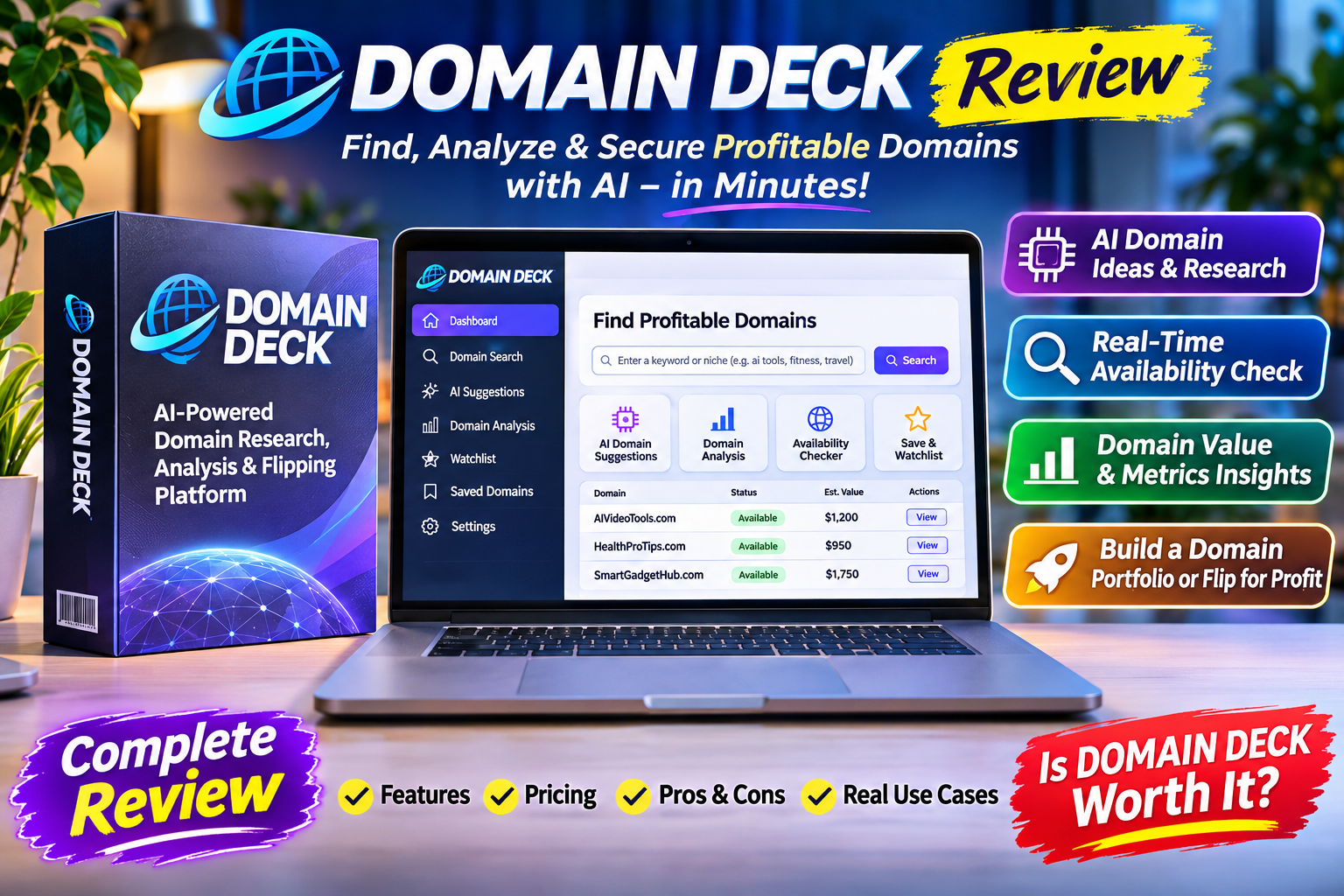
An expired-domain finder and AI price helper are also advertised. These features are intended to surface expired, undervalued, or potentially attractive domain names. They may interest domain investors, but automated valuations are only estimates. A name’s value depends on comparable sales, extension, brandability, buyer demand, trademark risk, backlink quality, spam history, and renewal cost. Treat an estimated value as a research lead, not a guaranteed resale price or profit forecast.
6. More Than 100 AI Models
Promotional coverage says DOMAIN DECK connects to more than 100 AI models and names model families such as GPT, Claude, Gemini, Grok, DeepSeek, Llama, Mistral, and Qwen. The exact model versions, front-end access, upgrade restrictions, and usage limits were not independently verified. Model count is not a quality benchmark. Ask which models are included, whether API costs are covered, how many requests are allowed, and whether fair-use limits apply.
7. Lead Database and AI Outreach
The offer is promoted with a database of more than one million domain-buyer leads and AI-assisted outreach messages. That may sound attractive to a new reseller, but the list’s origin, freshness, accuracy, geographic coverage, and permission status are essential details that need clarification.
Do not assume an included contact list is permission-based. In the United States, the FTC says commercial email must use accurate sender information and subject lines, include required advertising disclosures, a valid postal address, and a working opt-out, and honor opt-out requests. These rules also apply to business-to-business marketing. See the FTC CAN-SPAM compliance guide. Check applicable laws in every recipient’s country before sending campaigns.
8. Hosting and Additional Services
DOMAIN DECK is also advertised as supporting hosting packages and services such as website setup, SEO, design, and migration. Third-party coverage mentions free SSL and a 99.9% uptime claim. These are vendor-side claims that need confirmation in the actual hosting agreement. Ask who operates the servers, where data is stored, what backups and restore options exist, how support works, and whether renewal rates differ from introductory rates.
9. Monetization and Reseller Options
Promotional materials describe potential revenue from domain sales, hosting, additional services, affiliate offers, and advertising. These are business models, not guaranteed income streams. Results depend on customer acquisition, supplier costs, conversion rates, refunds, chargebacks, and the time required for support. The software does not automatically create demand for a new domain shop.
Potential Benefits
- Branded customer journey: A storefront may keep domain purchases connected to a freelancer’s or agency’s brand.
- Service bundling: Domain registration can be combined with hosting, website setup, maintenance, or design services.
- Research utilities: Search, DNS, WHOIS, and AI name tools may make basic research more convenient.
- Low advertised entry price: The reported launch price is small compared with building a custom reseller portal, although it does not cover the full cost of operating a business.
- Beginner positioning: Guided setup and training are promoted for people without development experience.
Drawbacks and Important Risks
- Underlying registrar not clearly identified: This is the biggest unanswered question. You need to know which accredited registrar actually registers names and how customers can identify it.
- Hosting provider not independently confirmed: Uptime, backups, support, server location, security, and renewal terms need written confirmation.
- Lead-list permissions are unclear: A large database is not automatically safe or lawful to use for unsolicited campaigns.
- AI model access is vague: The number of models does not explain which are included or what usage limits apply.
- Free-domain claims need explanation: Registrations and renewals have costs. Ask who pays those charges and what “free” covers.
- Business results are not guaranteed: You still need marketing, customer trust, supplier relationships, and ongoing support.
- Sales-page quality concerns: One third-party review reports repeated testimonials and placeholder-like screenshot text. These issues do not prove the software is defective, but they are reasons to verify claims rather than rely on testimonials.
The Registrar Question: What Buyers Must Verify
A reseller storefront is only as dependable as the registrar and infrastructure behind it. ICANN’s reseller framework recognizes a chain that can include registry operators, accredited registrars, resellers, and registrants. ICANN guidance says reseller arrangements should identify the sponsoring registrar and customers should be able to identify it. Read ICANN’s registrant rights and reseller guidance before taking customer orders.
Ask DOMAIN DECK support these questions in writing:
- Which ICANN-accredited registrar sponsors registrations made through the storefront?
- Will each customer be listed as the registered name holder with accurate contact information?
- Can customers obtain transfer authorization codes and move domains to another registrar?
- Who handles renewal reminders, renewals, expired-domain recovery, and DNS support?
- Who receives customer payments, issues refunds, and handles chargebacks?
- What are the wholesale costs, renewal rates, transfer fees, and supported extensions?
ICANN explains that renewal prices are set by registrars and may be higher than promotional first-year prices. Review its domain renewal and expiration FAQ. A reseller should disclose renewal pricing clearly rather than focus only on the first-year offer.
Explore DOMAIN DECK and Review the Offer
DOMAIN DECK Pricing and Upgrade Funnel
Public price reports do not match. The launch listing on MunchEye lists a $17 front-end price, while a third-party review reports a $12.41 checkout total. Because the official sales page was not directly accessible, I cannot confirm the current checkout price, whether taxes or coupons were included, or whether the amount has changed. Verify the live order form before paying.
The same third-party coverage lists six optional upgrades with these reported prices:
| Upgrade | Reported price | Reported additions |
|---|---|---|
| Domain Deck Pro | $67 | More tools, lead generation, website and funnel utilities |
| Domain Deck Enterprise | $197 | Dedicated hosting, business email, additional products and support |
| Domain Deck DFY | $97 | Templates and additional content or marketing tools |
| Domain Deck Reseller | $167 | Rights and assets to resell the software |
| Domain Deck IMX | $97 | Additional marketing and agency-oriented apps |
| Domain Deck WhiteLabel | $297 | Rebranding and selling the platform under your identity |
These are third-party reported figures, not a verified current price sheet. Confirm each upgrade’s contents, recurring charges, refund eligibility, and whether the feature is necessary. A low front-end price can lead to a much larger total if you buy several add-ons.
The funnel is also reported to advertise a 30-day refund period and launch coupons. I could not verify coupon validity or the written refund conditions. Read the checkout terms, save your receipt, and keep a copy of the refund policy before ordering.
DOMAIN DECK vs. Traditional Domain Reseller Options
DOMAIN DECK and established registrar programs are not identical. DOMAIN DECK is presented as a packaged storefront with AI and marketing extras. A registrar reseller program focuses more directly on registration infrastructure, wholesale pricing, and APIs or reseller panels.
| Option | Primary role | Best fit |
|---|---|---|
| DOMAIN DECK | Branded reseller storefront plus advertised AI and outreach tools | People wanting a packaged business front end |
| Name.com | Domain registration and developer services | Developers and businesses needing registrar services |
| Namecheap | Retail domain and hosting provider | Individuals and small businesses buying directly |
| Domain Name API | Domain reseller platform and API | Agencies and hosting providers building their own systems |
If you want more control and a clear registrar relationship, compare official reseller documentation and wholesale pricing directly. If you prefer a bundled storefront and marketing tools, DOMAIN DECK may be worth testing after its infrastructure questions are answered. For readers also considering website services, our VBiz WordPress Theme review covers a separate part of an agency workflow.
Who Should Consider DOMAIN DECK?
Freelance web designers, small agencies, domain hobbyists, and digital marketers may find the bundled storefront worth investigating if they already understand domain services and can support customers.
It is less suitable for anyone expecting instant passive income, guaranteed domain profits, or a completely hands-off registrar operation. It may also be a poor fit if you already have a trusted reseller account, established billing infrastructure, or advanced technical requirements that a packaged storefront cannot meet.
Frequently Asked Questions
What is DOMAIN DECK?
It is marketed as a cloud-based domain and hosting reseller storefront with domain research, AI helpers, lead generation, and outreach tools.
How much does DOMAIN DECK cost?
Launch coverage lists $17, while another review reports a $12.41 checkout total. Confirm the current price on the live order page.
Can I sell domains through my own brand?
The product is promoted as a branded domain storefront. Confirm the setup process, registrar relationship, supported extensions, and payment flow before selling to customers.
Are domains really free forever?
Promotional coverage mentions free-domain claims, but registrations and renewals have costs. Ask who pays those charges and what “free” covers.
Can I use the included lead database?
Do not use it until you understand its source, freshness, and permission status. Commercial email rules still apply.
Is there a money-back guarantee?
Third-party coverage reports a 30-day refund promise. Verify the current written policy and process on the checkout page.
Final Verdict: Is DOMAIN DECK Worth Considering?
DOMAIN DECK presents an interesting packaged approach to domain reselling. A branded storefront, configurable retail prices, domain lookup tools, AI-assisted name ideas, and hosting add-ons could be useful to a freelancer or small agency that already has clients asking for domain and website services. The reported low front-end price may make it tempting to test.
However, the most important business details remain unverified. The public information reviewed here does not clearly identify the sponsoring registrar or hosting provider, and it does not establish exact costs, renewal terms, transfer processes, AI usage limits, or lead-list permissions. Those details determine whether you can safely sell domains and support customers over time.
My verdict: DOMAIN DECK is worth investigating as a possible storefront and workflow tool, but I would not build a customer-facing domain business around it until the vendor answers the registrar, customer ownership, renewals, transfers, hosting, and lead-compliance questions in writing. Start with a small test, verify a real registration and customer control, and avoid expensive upgrades until the front end proves useful. Treat income and automation claims as marketing—not a business plan.
Check DOMAIN DECK Availability and Terms
Affiliate Disclosure
This article contains an affiliate link. If you purchase DOMAIN DECK through the link on this page, Top10ReviewPoint may earn a commission at no additional cost to you. Review the current checkout price, supplier details, license, renewal terms, and refund policy before making a purchase.