
PLR Fiction Architect is presented as a fiction-planning tool with a private-label-rights (PLR) offer. The available product description says its browser-based HTML app builds a detailed master prompt from choices such as genre, story length, tone, point of view, and ending. Users then copy that prompt into ChatGPT, Claude, or Gemini to plan a story and draft it chapter by chapter.
This distinction is important: the available evidence describes a prompt-building workflow, not a fully autonomous novel-writing platform. The external AI service appears to do the actual text generation. The PLR element may interest digital-product sellers who want to rename or rebrand the app, but the exact license must be checked before resale. This is a research-based review; we have not claimed hands-on testing.

PLR Fiction Architect at a Glance
- Product: PLR Fiction Architect / Fiction Architect App PLR
- Vendor attribution: Francis Ochoco and partners, according to an independent product listing
- Type: Browser-based HTML prompt builder with a reported PLR offer
- Purpose: Assemble a master prompt for AI-assisted fiction planning and drafting
- AI tools named: ChatGPT, Claude, and Gemini
- Rights: Non-exclusive PLR is reported; exact permissions remain to be confirmed
- Price references: Third-party listings show $17 and $14.01 snapshots; current checkout price is unverified
What Is PLR Fiction Architect?
According to an independent review listing, Fiction Architect is a browser-based HTML application that collects a writer’s preferences and turns them into a detailed master prompt. The user chooses creative parameters, copies the generated prompt, and pastes it into an AI assistant. The AI can then help develop the story plan, wait for the user’s approval, and draft chapters in stages.
That makes the app a structured briefing tool. It may help beginners think through decisions before asking an AI to write. It does not remove the need for a writer to develop the premise, judge the outline, revise the prose, and check continuity. Nor does the available evidence establish that the app includes its own AI model, generation credits, manuscript hosting, or a full text editor.
The PLR positioning is aimed at people who may want to rename or rebrand the app for their own audience. The listing describes the rights as non-exclusive and mentions an app-renaming tool. A third-party description is not a license agreement, however. Buyers should inspect the actual license and confirm precisely what may be edited, hosted, bundled, or resold.
How the Workflow Works
The reported process has three main stages. First, users select story settings such as genre, length, tone, point of view, and ending. Second, Fiction Architect combines those choices into a master prompt. Third, the user transfers the prompt to ChatGPT, Claude, or Gemini and asks the model to create a story plan and draft chapters after the plan is reviewed.
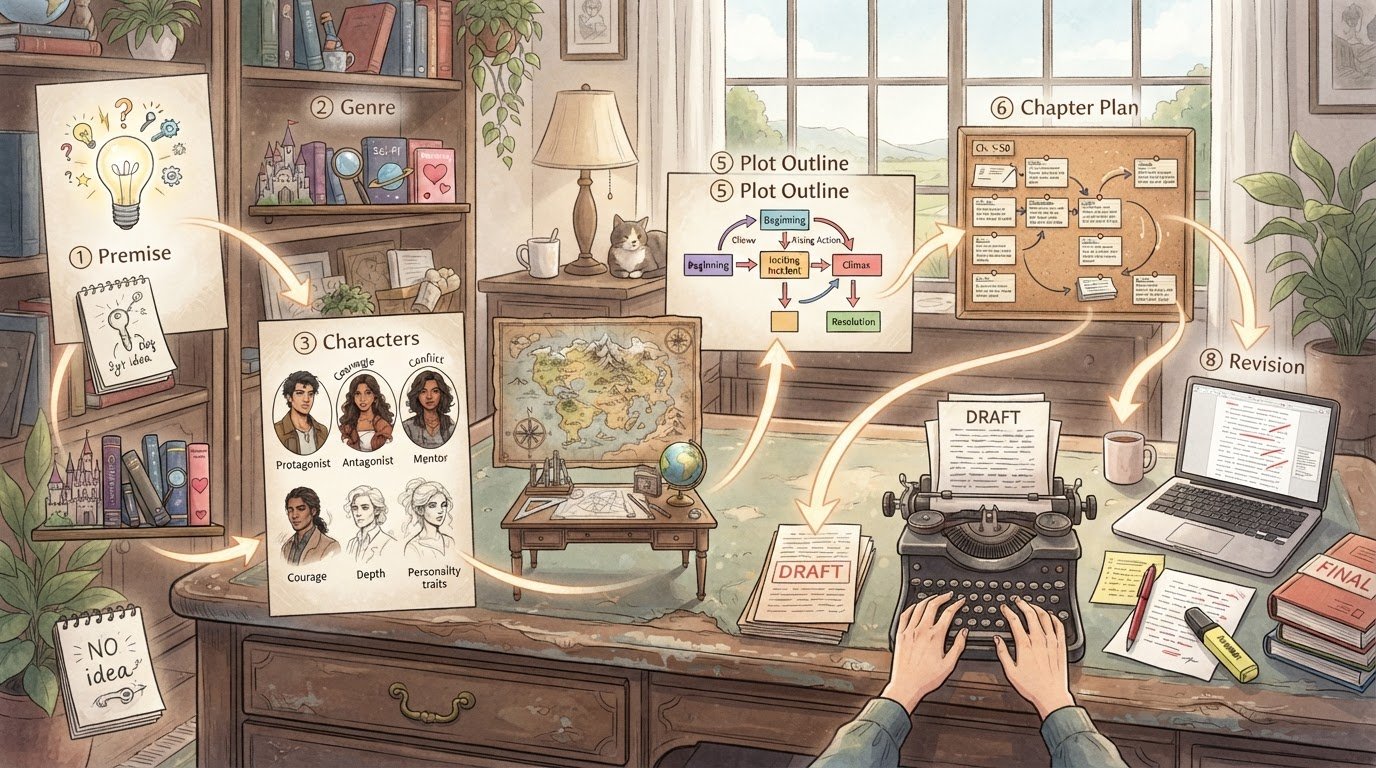
This approach can make a large writing project feel more manageable because it separates planning from drafting. It also gives the writer a chance to approve the outline before generating pages of prose. The trade-off is that users must move between the prompt builder and the external AI platform, then keep track of their manuscript and notes.
Key Features
Guided story inputs
The listing specifically names genre, length, tone, point of view, and ending. These settings matter because a mystery, romance, thriller, and fantasy novel have different reader expectations. Choosing them in advance can make an AI brief more specific than a generic instruction to write a story.
Master-prompt generation
The central reported feature is the ability to create a detailed prompt from the selected preferences. A reusable prompt can save time for people who frequently brainstorm different fiction ideas. It may also provide a repeatable starting structure for users who are still learning how to brief an AI model.
Compatibility with external AI assistants
ChatGPT, Claude, and Gemini are named in the product description. That flexibility may be useful if a writer already has an account with one of those providers or wants to compare outputs. However, the listing does not establish that AI subscriptions or usage credits are included. Users should budget for any separate provider costs and limits.
Story planning and chapter drafting
The described workflow asks the AI to plan a story and then draft it chapter by chapter after the user approves the plan. Working in stages can make it easier to review the plot and adjust direction. It does not guarantee consistent characterization or a publication-ready manuscript; those depend on the model, the instructions, and the author’s editing.
Browser-based app and reported rebranding
The app is described as browser-based HTML, and the PLR offer reportedly includes a renaming feature. This may reduce the barrier for a marketer who wants to put their own branding on a small digital tool. Yet the public description does not verify browser support, offline use, mobile behavior, hosting requirements, source-file access, or update arrangements.
Potential Benefits
A more complete starting brief: Guided choices can remind new writers to define basic story requirements before asking an AI for an outline.
Less repetitive prompt writing: A structured builder may reduce the time spent composing similar instructions for multiple projects.
Model flexibility: The described copy-and-paste process may work with several named AI assistants rather than tying the user to one model.
Staged drafting: Reviewing a story plan before drafting chapters gives the writer a checkpoint to identify weak plot logic or mismatched expectations.
Possible PLR use: If the license permits the intended business model, buyers may be able to rebrand the app or include it in a relevant digital-product package. This is only a possible use case, not a promise of sales or income.
Drawbacks and Limitations
- External AI dependency: The available description says users paste prompts into another AI service. The app should not be mistaken for a complete AI subscription.
- No guaranteed story quality: Detailed prompts can guide a model, but they cannot ensure originality, strong pacing, believable dialogue, or commercial success.
- Continuity still needs attention: AI drafts can contain timeline errors, repeated scenes, inconsistent character details, and unresolved plot threads.
- Limited product verification: The official GroovePages landing page supplied for this review could not be retrieved by the research browser. Exact deliverables, refund terms, support, updates, and license wording remain unverified.
- Non-exclusive rights: Other buyers may have access to the same underlying app or assets. Rebranding does not create exclusive ownership.
- Seller responsibilities: Resellers may need to arrange hosting, branding, sales pages, customer support, and technical help. PLR does not automatically create a profitable business.

Pricing: What Does It Cost?
Pricing references are not fully consistent. An independent product listing displays a front-end price of $17. A WarriorPlus launch-calendar listing separately shows $14.01. These may be different snapshots or promotional conditions; neither confirms the live checkout price today.
Before purchasing, check the vendor’s current sales page and checkout for the exact amount, currency, optional upgrades, recurring charges, and included files. The sources reviewed did not establish a verified subscription price, the contents of any upsell, or whether AI credits are included. If the app relies on ChatGPT, Claude, or Gemini, a separate AI account may be necessary.
Who Should Consider It?
- Beginner fiction writers: People who have a story idea but struggle to create a detailed AI brief may value a guided prompt workflow.
- AI-assisted authors: Writers already using ChatGPT, Claude, or Gemini may appreciate a repeatable starting point.
- PLR sellers: Marketers interested in a rebrandable writing-related app can investigate the offer if the license matches their intended resale plan.
- Writing educators: Coaches may evaluate it as a supplemental prompt-planning resource, subject to license permission.
It may be less suitable for professional authors who need a persistent manuscript editor, version history, story bible, detailed continuity tracking, collaboration, and export tools. A dedicated writing platform is likely a better fit for those requirements.
PLR Fiction Architect vs. Alternatives
| Tool | Main purpose | Published pricing information | Best fit |
|---|---|---|---|
| PLR Fiction Architect | Master-prompt builder with reported PLR rights | Third-party price snapshots: $14.01 and $17; live price unverified | Prompt-led planning and possible rebranding |
| Novelcrafter | Novel planning and writing workspace with Codex, outlining, AI connections, and collaboration | Official page lists $4, $8, $14, and $20 monthly tiers | Authors who need a persistent story workspace |
| Sudowrite | AI toolkit for brainstorming, planning, writing, and editing fiction | Check its current official pricing page | Writers seeking AI help across the creative process |
| ChatGPT, Claude, or Gemini | General AI assistants that can brainstorm, outline, and draft from detailed instructions | Plans and usage limits vary by provider | Writers who prefer to build their own prompts |
Novelcrafter is a stronger fit when the writer wants a dedicated environment. Its official feature pages describe a Codex for organizing characters, places, and story lore, plus planning views, manuscript tools, AI connections, and collaboration. Its pricing page lists Scribe at $4 per month, Hobbyist at $8, Artisan at $14, and Specialist at $20, along with a 21-day trial. Check the official page for current terms.
Sudowrite is specifically positioned as an AI toolkit for novelists. Its documentation describes brainstorming, planning, writing, editing, and organizing fiction, including creating a Story Bible from notes. It may suit writers who want AI assistance integrated more directly into the creative process.
General AI assistants can perform many of the same prompt-led tasks without a separate prompt builder. The user must define the genre, audience, tone, characters, setting, plot, and chapter requirements manually, but may prefer that flexibility over a separate app.
For readers comparing fiction-focused digital products, see our related Fiction Goldmine Engine PLR review and historical cozy mystery prompts review.
How to Use AI for Better Fiction Drafts
Start with a premise that has a clear conflict and a reason readers should care. Define the intended audience, genre, tone, point of view, approximate length, and content boundaries. Ask the AI for an outline first, not a complete manuscript. Check that the protagonist has a meaningful goal, the obstacles escalate, supporting characters have distinct motivations, and the ending resolves the central conflict.
Keep a separate continuity document for character details, locations, dates, world rules, and unresolved plot threads. Draft in manageable chapters and compare each one with the outline. Rewrite generic dialogue, remove repetitive exposition, and make sure scenes reveal character or move the plot forward. Read the manuscript carefully and consider human editing before publication.
PLR License and Copyright Checks
Before using the app commercially, read the actual license. Confirm whether you may change the name and branding, edit the files, host the app on your own domain, sell unlimited copies, include it in paid memberships, bundle it with other products, or pass any rights to your customers. Check restrictions on free distribution, sublicensing, source-code access, and use of the vendor’s branding. Keep a copy of the license and purchase receipt.
Do not call non-exclusive PLR exclusive ownership. Also remember that the app’s license does not automatically grant copyright in every AI-generated story. The U.S. Copyright Office explains that copyright protection depends on human authorship; prompts alone do not automatically make all AI output protectable. Writers should add meaningful human creative expression and consult current official guidance when publishing or registering a work.

Pros and Cons
Pros
- Guided story inputs for genre, length, tone, point of view, and ending.
- Creates a reusable master prompt.
- Reported compatibility with ChatGPT, Claude, and Gemini.
- Chapter-by-chapter planning can make review easier.
- Reported PLR and app-renaming options may interest digital sellers.
Cons
- Official sales page could not be independently retrieved.
- Current price, deliverables, refund policy, and exact license remain unverified.
- External AI access may involve separate costs and limits.
- Not verified as a full manuscript editor or continuity-management suite.
- Non-exclusive PLR does not guarantee uniqueness or sales.
- AI drafts still require substantial human editing.
Frequently Asked Questions
Is PLR Fiction Architect a standalone AI writing platform?
The available listing describes a browser-based HTML app that builds a master prompt for use in ChatGPT, Claude, or Gemini. It does not establish that AI generation is included inside the app.
Can it write a complete novel automatically?
The described workflow lets an external AI plan a story and draft chapters after the user reviews the plan. It does not guarantee a complete, publication-ready novel.
Which AI tools are mentioned?
The independent product description names ChatGPT, Claude, and Gemini. Confirm current compatibility with the vendor.
Does it include PLR rights?
A third-party listing reports non-exclusive PLR and an app-renaming feature. The actual license was not available for independent verification, so review it before resale.
What is the current price?
One listing displays $17 and a launch calendar shows $14.01. These are historical listing references, not a verified live checkout price.
Do I need a paid AI account?
The product listing does not specify account requirements or include AI credits. Free-tier access may have limits; check each provider’s current plans and terms.
Can I sell books created with it?
That depends on the AI provider’s terms, the human contribution to the manuscript, marketplace rules, and applicable copyright law. The app’s PLR license does not settle the rights to every AI-generated passage.
Is it better than Novelcrafter or Sudowrite?
They solve different problems. Fiction Architect appears focused on prompt building and a reported PLR offer. Novelcrafter provides a persistent writing workspace, while Sudowrite is an AI fiction toolkit. Choose based on the tools and rights you actually need.
Final Verdict: Is PLR Fiction Architect Worth Considering?
PLR Fiction Architect may be worth investigating for beginners who want a guided way to prepare fiction prompts and for digital-product sellers interested in a rebrandable writing-related app. Its most appealing reported function is simple: choose story preferences, create a structured master prompt, and use an external AI assistant to plan and draft in stages.
However, the evidence is incomplete. The official GroovePages page could not be retrieved, and the current checkout price, full deliverables, license wording, refund policy, support, and update terms could not be confirmed. Treat it as a prompt-building aid with a reported PLR component—not as a proven all-in-one novel-writing SaaS or a guaranteed publishing business.
Our recommendation: Consider buying only if the live offer and license clearly support your intended use and you are comfortable working with a separate AI assistant. Authors who need a full manuscript environment, continuity tools, and collaboration should compare Novelcrafter and Sudowrite before deciding.
Visit the PLR Fiction Architect offer | Check the offer through our affiliate link
Affiliate Disclosure: This article contains affiliate links. If you purchase through these links, Top10ReviewPoint may earn a commission at no additional cost to you. This does not change our commitment to presenting product details, limitations, and uncertainties honestly. Always review the vendor’s current offer, checkout terms, and license before purchasing.